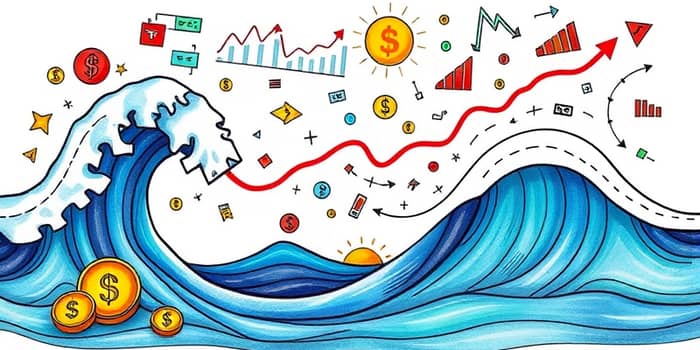
In the vast ocean of finance, markets move with a predictable yet mysterious rhythm, much like the changing seasons.
This dance of ups and downs, known as market cycles, shapes the fortunes of investors and economies alike.
By grasping these patterns, you can transform uncertainty into advantage and make informed decisions that stand the test of time.
Market cycles are not just abstract concepts; they are the heartbeat of financial markets, influencing everything from stocks to real estate.
At their core, market cycles describe the recurring patterns of growth and decline in asset prices.
They are driven by a complex interplay of economic indicators and investor psychology, creating waves that can last from days to decades.
Typically, these cycles average 5 to 7 years, but their duration varies based on factors like regulations or technological innovations.
To navigate them effectively, it's essential to understand their key phases and how they impact your investments.
From an economic perspective, cycles unfold through four primary stages that mirror broader business trends.
These phases provide a framework for anticipating shifts in the market environment.
These phases flow seamlessly into one another, creating a continuous loop that shapes financial landscapes.
Investor behavior offers another view, with cycles divided into accumulation, markup, distribution, and markdown phases.
This table summarizes these phases to help you recognize psychological shifts in the market.
By monitoring these phases, you can adjust your strategies to align with market sentiment and trends.
Recognizing early signs, such as shifts in volume or news cycles, can provide a competitive edge.
Market cycles vary in duration and scope, broadly categorized into cyclical and secular types.
Understanding these distinctions helps tailor your approach to different time horizons.
Additionally, commodity-specific cycles, such as super cycles, highlight the importance of supply-demand dynamics, averaging about 6 years according to the World Bank.
Sector variations also play a role, with cyclical stocks rising and falling with the economy, while non-cyclical ones like staples remain more stable.
Several factors influence the progression of market cycles, and being aware of these can aid in identification.
While prediction is challenging, these indicators offer clues to navigate the ebb and flow of markets.
Despite these tools, cycles remain inherently unpredictable, emphasizing the need for flexibility and a long-term perspective.
Throughout history, market cycles have recurred, offering valuable lessons from past events like recessions or bubbles bursting.
Commodity cycles, for instance, demonstrate clear links between supply and demand, teaching us about resource dynamics and economic resilience.
By studying these examples, you can gain insights, but remember that each cycle is unique, shaped by contemporary factors and innovations.
This historical awareness fosters a mindset of continuous learning and adaptation in your investment journey.
Navigating market cycles effectively requires a blend of knowledge and action, with strategies tailored to different phases.
Here are some practical approaches to help you thrive in any market environment.
Market cycles are not a holy grail for perfect timing, but they provide a framework for making informed choices and managing expectations.
In conclusion, market cycles are the heartbeat of finance, offering both challenges and opportunities for growth.
By understanding their rhythms, you can transform uncertainty into advantage and build a resilient investment strategy.
Embrace the ebb and flow, stay informed through continuous learning, and adapt your approaches as cycles evolve.
Whether you're a seasoned investor or a beginner, this knowledge empowers you to ride the waves of finance with confidence and foresight.
Let the cycles guide you, not control you, and may your financial journey be as dynamic and rewarding as the markets themselves.
Remember, success lies in patience, perspective, and the willingness to learn from each phase of the cycle.
References