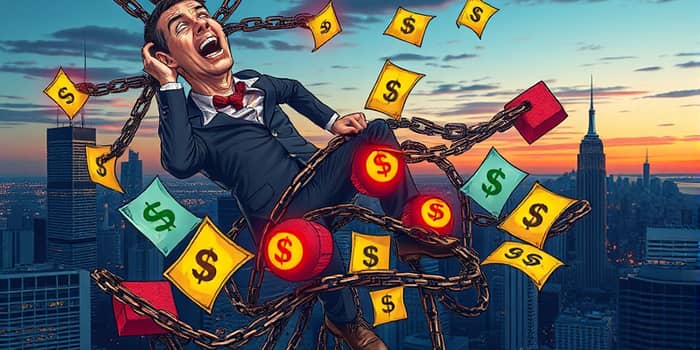
In the relentless pursuit of financial growth, many business owners and individuals turn to innovative funding methods to seize opportunities or weather storms.
Loan stacking emerges as a tempting shortcut, promising rapid access to capital beyond what a single loan might offer.
This practice, while not illegal, can deceive borrowers into believing they are diversifying risk, when in reality, it often sets the stage for a devastating financial collapse.
By exploring the intricacies of loan stacking, this article aims to empower you with knowledge to navigate lending landscapes safely.
Understanding its pitfalls is the first step toward building a resilient financial future, free from the traps of over-leverage.
Let’s delve into what loan stacking entails and why it frequently leads to more problems than solutions.
Loan stacking refers to the act of applying for and obtaining multiple loans from different lenders within a very short timeframe.
It is particularly common in the realm of online lending, where approval processes are swift and often outpace updates to credit reports.
This lag allows borrowers to accumulate significant debt before new inquiries appear, creating a temporary illusion of financial viability.
For businesses, it might involve layering a new loan on top of an existing one without prior repayment, effectively doubling or tripling debt obligations.
While it can seem like a clever way to secure quick capital, the long-term consequences are rarely favorable.
Borrowers exploit the delay in credit reporting by submitting applications to various lenders simultaneously or in rapid succession.
Online platforms, with their minimal underwriting times, facilitate this by approving loans before previous applications are reflected in credit histories.
This method can enable individuals or businesses to secure sums they might not qualify for individually, but it comes with hidden costs.
The process often bypasses traditional checks on repayment capacity, leading to a buildup of debt that exceeds sustainable limits.
In essence, it’s a race against time, where the initial gains are quickly overshadowed by mounting financial pressures.
At first glance, loan stacking offers several appealing advantages, though they are typically short-lived.
These benefits can be enticing, especially for those in desperate situations, but they are often eclipsed by severe risks.
It’s crucial to recognize that what starts as a solution can quickly become a compounding problem.
Loan stacking initiates a negative debt cycle that overwhelms borrowers, similar to maxing out multiple credit cards.
The risks are multifaceted and impact both personal and business finances profoundly.
To illustrate the severity, consider the following table that outlines key risk categories.
This table underscores how loan stacking transforms from a quick fix into a financial trap with lasting repercussions.
Beyond these categories, the emotional toll on borrowers can be immense, affecting mental health and decision-making.
Lenders see loan stacking as a major red flag due to its association with high default rates and financial losses.
Many include explicit bans on stacking in their agreements to protect their collateral priority and ensure repayment.
Predatory lenders might encourage this practice with hidden fees, exploiting borrowers’ urgent needs for profit.
Enhanced underwriting techniques now detect stacking through recent credit inquiries, often leading to application denials.
This shift highlights the growing awareness of its dangers within the lending industry.
Data from studies like the TransUnion 2015 report reveal that loan stacking accounted for 7.8% of total charge-offs, amounting to $39 million.
For instance, a business needing $60,000 might stack a $20,000 loan with a $40,000 one, leading to unsustainable payments.
Another example is using a real estate loan combined with a line of credit for operational costs, which can be safe only with full disclosure.
These cases demonstrate how easily intentions can spiral out of control when multiple debts accumulate.
It’s a stark reminder that more lenders do not equal more safety; instead, they often compound risks.
Avoiding loan stacking is crucial for long-term financial health; consider these alternatives instead.
These approaches provide sustainable funding without the pitfalls of stacking.
To safeguard your finances, implement these actionable measures.
By following these steps, you can build a robust financial foundation that resists the temptation of quick fixes.
Developing resilience against loan stacking requires a shift in perspective towards long-term stability over short-term gains.
Embrace patience in financial planning, recognizing that sustainable growth often comes from disciplined, incremental efforts.
Surround yourself with a support network of professionals and peers who can offer guidance and accountability.
Remember, financial health is not just about accessing capital but managing it wisely to avoid overwhelming debt cycles.
This mindset empowers you to make informed decisions that align with your goals and values.
Loan stacking, while initially appealing, is a precarious practice that frequently backfires by leading to insurmountable debt and credit damage.
By understanding its mechanisms, risks, and alternatives, you can navigate lending landscapes with confidence and caution.
Prioritize transparency, credit health, and strategic planning to secure funding that supports rather than undermines your financial future.
Let this article serve as a guide to help you avoid the pitfalls of false diversification and build a path toward lasting prosperity.
References