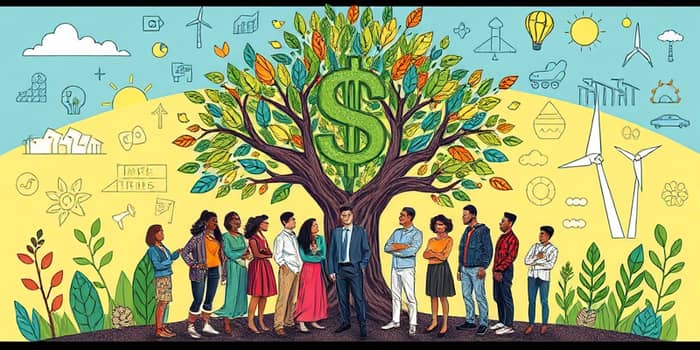
In a world where financial markets pulse with the promise of profit, a new movement is redefining success by bridging capital with conscience. Values-based investing allows investors to channel resources toward companies and projects that reflect deeply held beliefs. Far from a niche trend, this approach has soared to a US sustainable AUM of $6.6 trillion, demonstrating that meaningful impact and strong returns can coexist.
Investing decisions aligned with moral principles can transform portfolios into powerful tools for social and environmental change. By weaving ethics into asset allocation, individuals and institutions gain peace of mind and fuel innovation in renewable energy, social housing, biodiversity, and more.
Values-based investing (VBI) emerged centuries ago with faith communities avoiding investments in slavery or alcohol. Today it encompasses a spectrum of strategies that evaluate not only profit potential but also social and environmental impact.
These approaches can be combined or tailored to individual priorities, creating a highly personalized investment experience.
Adopting a values-driven portfolio brings more than just a competitive yield. It cultivates a sense of alignment and satisfaction that traditional strategies often lack. Investors report enhanced confidence, stronger commitment during market volatility, and the joy of supporting positive change.
Creating a purposeful portfolio begins with introspection and research. Follow a structured process to ensure your financial ambitions and ethical principles converge seamlessly.
Customization drives stronger engagement by ensuring your money works as hard for your beliefs as it does for your long-term goals.
As of 2026, climate action remains the top driver, with 86% of thematic investments in energy transition and 76% in clean innovation. Biodiversity and nature-based solutions are emerging rapidly, despite representing only 1% of climate-themed ETF assets. Private finance in nature and biodiversity has potential to unlock up to $10.1 trillion in economic value and create millions of jobs.
Technologies like AI, food security initiatives, and indigenous rights advocacy are gaining traction, further broadening the scope of values-based portfolios. At the same time, evolving global regulations reinforce transparency and materiality in ESG reporting.
Despite robust growth, values-based investing faces headwinds. The absence of universal standards can lead to inconsistent measurements, while excluding entire sectors may constrain diversification. Some portfolios incur higher fees or underperformance if exclusions target large-cap sectors indiscriminately.
Political shifts have sparked debate over ESG terminology, yet the underlying drive for sustainable and responsible investment remains resilient. By adopting clear definitions, leveraging third-party data, and focusing on material risks, investors can mitigate these challenges.
Transparent reporting and rigorous due diligence are essential to maintain both financial integrity and values alignment.
Faith-based funds historically avoided alcohol and tobacco, creating early models for ethical exclusion. Modern faith investors now screen for gun violence, renewable energy, and diversity initiatives in alignment with doctrinal values. Impact investors have financed affordable housing projects that not only generate steady income but also revitalize underserved neighborhoods.
Engagement-driven shareholders have compelled major corporations to set science-based climate targets and enhance board diversity, delivering measurable environmental and governance improvements alongside above-benchmark returns.
These stories illustrate how investor influence can spark corporate transformation and drive both profit and purpose.
Investing with purpose is more than a strategy—it is a movement toward a future where capital empowers positive change. By aligning your portfolio with your convictions, you become part of a global effort to build sustainable communities, protect the planet, and secure financial well-being for generations to come.
References