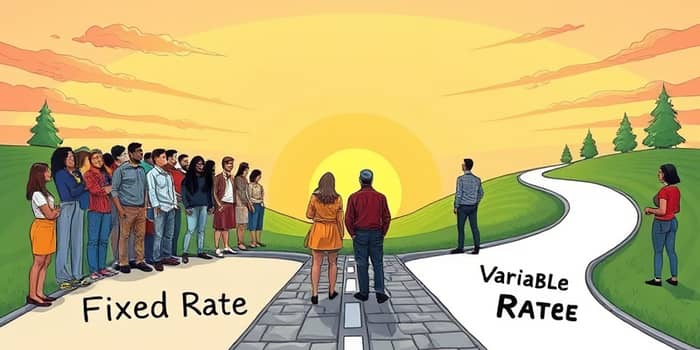
When you stand at the threshold of a major financial decision, choosing between fixed and variable loan rates can feel like charting two very different journeys. Both paths offer unique benefits and inherent risks, and the right choice can empower you with long-term stability or unlock potential savings. This comprehensive guide equips you with the insights and questions you need to make an informed decision aligned with your goals and risk tolerance.
Fixed interest rates stay the same throughout your loan’s term, giving you a reliable monthly payment. When you lock in a fixed rate, you know exactly what you’ll pay each month, no matter how market rates shift.
In contrast, a variable interest rate ties itself to an index—such as the prime rate or SOFR—and adds a constant margin determined by your lender. As that index rises or falls, your monthly payment can fluctuate, offering both opportunities for savings and the risk of higher costs.
Deciding between consistency and flexibility often comes down to how you manage risk and plan for the future. Fixed rates deliver predictability; variable rates deliver agility.
Between January 2022 and July 2023, economic volatility drove some variable mortgage rates up by more than five percentage points. Borrowers who locked in fixed rates before this surge experienced peace of mind during uncertain times, while those on variable plans saw rapidly escalating payments.
Yet history shows such dramatic swings are rare. In more stable periods, variable rates can drop, offering borrowers potential savings if rates decline. Imagine paying off a student loan or credit card faster because your rate dipped mid-term.
Consider two homeowners:
Both made choices that fit their timelines, comfort with risk, and long-term goals. Your journey will reflect your own circumstances and ambitions.
Use this guide to align your preferences with the loan type that suits you best:
Before you commit, reflect on these key considerations:
First, shop around and compare both rate types from multiple lenders. Even small differences in margin or index calculations can add up over time. Second, examine your long-term plans: if you anticipate a career move, home sale, or major life event, a variable rate may yield savings. If stability and stress-free budgeting are paramount, a fixed rate is often the wiser choice.
Next, consider hybrid options. Some loans let you start with a variable rate and switch to a fixed rate later, offering a balance between opportunity and protection. If you choose this route, build a financial cushion to handle potential rate spikes before conversion.
Finally, maintain an emergency fund. Regardless of rate type, having three to six months of expenses in reserve gives you the resilience to navigate unexpected payment hikes, market swings, or personal setbacks.
Your choice between fixed and variable interest rates shapes more than monthly payments—it reflects your values, plans, and appetite for risk. By understanding the mechanics of each, asking critical questions, and applying informed decision-making with confidence, you transform uncertainty into opportunity and chart a course toward lasting financial well-being.
Whether you embrace the rock-solid consistency of a fixed rate or the adaptable potential of a variable rate, you hold the power to choose a path that aligns with your dreams. Let this guide be your compass as you embark on a journey of informed choices, empowered planning, and the bright horizon that awaits.
References